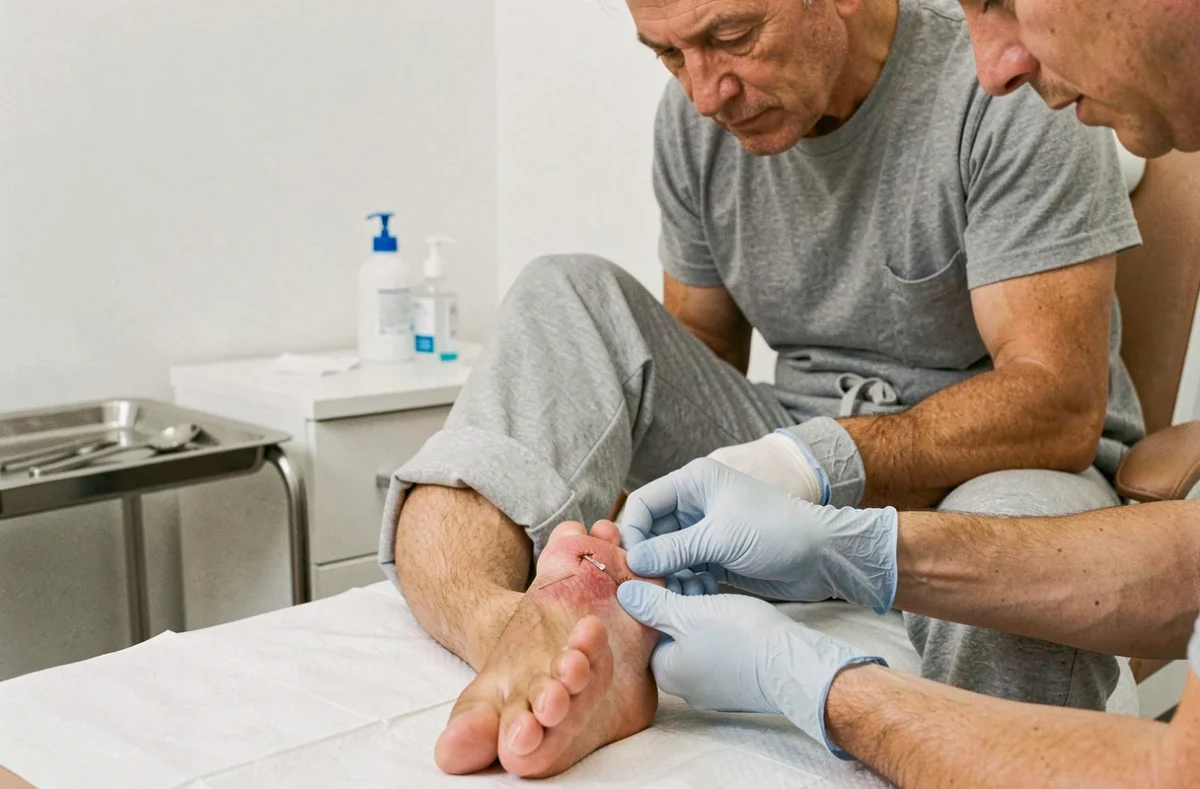
A nail that digs into the flesh of the big toe, a pain that prevents normal walking: when local care is no longer sufficient, surgery becomes the solution. Before making an appointment, the question of cost and coverage quickly arises. The price of an ingrown nail operation varies according to several parameters that most patients discover too late.
CCAM Code and reimbursement base: the real starting point
When a surgeon announces a global fee for an ingrown nail operation, this amount does not indicate what Health Insurance will cover. The reimbursement depends on the code of the act listed in the nomenclature, not on the price displayed by the practitioner.
Specifically, each surgical procedure has a CCAM code (Common Classification of Medical Acts). It is this code that determines the reimbursement base of Social Security. The same clinical result can correspond to acts coded differently depending on the technique used, and thus to distinct reimbursement bases.
Before any intervention, ask the surgeon for the exact code of the act he plans to bill. Without this information, it is impossible to calculate your actual out-of-pocket expenses. A detailed guide on reimbursement and price of ingrown nail operation helps to better anticipate these amounts according to your situation.

Surgeon’s and anesthetist’s fee overruns
The cost of the operation is broken down into several billing lines. The surgeon bills for the act, the anesthetist bills separately, and additional fees may be added. Each professional can apply their own fee overrun.
Health Insurance does not reimburse these overruns. A sector 2 surgeon, for example, freely sets their fees above the conventional rate. The anesthetist can do the same, independently of the surgeon.
Request separate quotes before the intervention
You have the right to receive a detailed quote from each participant. This is the only way to know precisely what amount will remain your responsibility after reimbursement from Social Security and your complementary health insurance.
- The surgeon’s quote must mention the CCAM code, the fee for the act, the amount of any potential overrun, and the reimbursement base of Health Insurance.
- The anesthetist’s quote specifies the type of anesthesia planned (most often locoregional for the ingrown nail) and their own fees.
- Hospital stay or operating room fees, even on an outpatient basis, may appear on a third document issued by the facility.
Comparing these quotes with the guarantees of your mutual insurance before confirming the date of the intervention avoids unpleasant surprises later on.
Health mutual and ingrown nail operation: what changes depending on contracts
The portion reimbursed by your complementary health insurance depends on the level of coverage subscribed. Not all contracts cover fee overruns in the same way.
A contract called “100% BR” (reimbursement base) reimburses the entire conventional rate, but nothing for the overrun. A “200% BR” or “300% BR” contract covers part or all of the overrun depending on its extent. It is the fee overruns that increase the out-of-pocket expenses, not the base rate of the act.
The case of Solidarity Complementary Health
Beneficiaries of the CSS (Solidarity Complementary Health) may think that all costs related to an operation are automatically covered. This is not systematic. Coverage assumes that the intervention is a medically justified and reimbursable act. An operation aimed solely at aesthetics does not open the same rights.
Moreover, some additional costs (hospital package, flat-rate contributions) may vary depending on the insured’s situation. Some people are exempt from them, others are not. Checking the precise conditions with your health insurance fund remains necessary.
Outpatient intervention and stay fees: a common trap
The ingrown nail operation is most often performed on an outpatient basis. You enter and leave the same day. Many patients conclude that no stay fees will be charged.
An outpatient intervention can generate stay fees related to the use of the operating room, post-operative monitoring, or the daily hospital package. These fees depend on the facility (private clinic or public hospital) and your coverage.
Locoregional anesthesia and its impact on cost
The most common anesthesia for this surgery is locoregional: it numbs the area from the ankle to the toes. It has the advantage of limiting risks and reducing the need for painkillers after the intervention. Its cost is generally lower than that of general anesthesia, which can lighten the total bill.
A preoperative consultation with the anesthesiologist is mandatory. This consultation is itself a reimbursable act, but again, a potential fee overrun may apply.
Summary of expense items that make up the bill
| Expense Item | Covered by Health Insurance | Covered by mutual insurance |
|---|---|---|
| Surgical act (conventional rate) | Yes, according to the CCAM reimbursement base | Yes, supplement to the co-payment |
| Surgeon’s fee overrun | No | According to the level of coverage |
| Anesthetist’s fees | Yes for the conventional part | According to the level of coverage |
| Hospital package / stay fees | Partially or exemption possible | Generally yes |
| Preoperative consultation with anesthetist | Yes | Yes |
The actual out-of-pocket expense is calculated by adding all uncovered overruns. Two patients operated on for the same ingrown nail, in the same facility, may have very different bills depending on their mutual insurance contract and the conventional sector of their practitioners.
The most useful reflex remains to collect quotes before the operation and to send them to your complementary health insurance for a written estimate of the coverage. This simple exchange avoids discovering an unexpected out-of-pocket expense several weeks after the intervention.