
Ludika Studio designs playful devices for educational purposes, primarily cultural serious games. For organizations looking to enhance their visual communication through play, the studio offers a range of services from custom game design to gamification training. Here, we will detail the technical and regulatory aspects that public presentations often overlook.
Digital Accessibility and Serious Games: RGAA Constraints on Visual Deliverables
A playful device delivered in digital form (web application, interactive book, touchscreen in cultural mediation) now falls under the scope of the European Accessibility Act, applicable since June 28, 2025. Micro-enterprise service providers are exempt, but the client remains responsible for the compliance of the deliverable as soon as it is shared with the public.
The RGAA, the French reference framework, imposes 106 criteria divided into 13 themes. For a serious game, critical points concern text alternatives for each visual element (cards, tokens, scenario illustrations), keyboard navigation in interactive interfaces, and color contrast on game pages.
In practical terms, a studio delivering an online game without an accessibility statement or description of accessible functionality exposes its client to a compliance failure. We recommend requiring, from the specifications, a partial RGAA audit covering at least the themes of “images,” “colors,” and “navigation.”

Among the services offered by Ludika Studio, the creation of custom serious games represents the core business, but it is the upstream support (needs audit, educational scripting, prototyping) that determines the quality of the final product.
Educational Game Design: Game Mechanics and Custom Scenarios
Gamification is not just about adding points and badges to existing content. An effective serious game relies on the alignment between playful mechanics and educational objectives. An investigative game designed to convey the history of a heritage site does not engage the same mechanisms as an internal awareness campaign in a company.
Ludika Studio relies on the framework of the DU “Learning through Play” from INSPE Lille to structure its devices. The development process follows an iterative logic:
- Audit phase: identification of messages to convey, target audience (novice or experienced players), and material constraints (physical box, screen, museum space).
- Prototyping phase: creation of a testable alpha version, with short scenarios and simplified mechanics, to validate engagement before producing the final edition.
- Production phase: graphic development, writing rules, manufacturing components (cards, tokens, boards) or digital development according to the chosen medium.
The difference between a functional playful tool and a forgotten gadget often lies in the quality of prototyping. A test with a small panel of players allows for identifying scenarios that fall flat before committing to the production budget.
Murder Parties and Investigative Games: Calibrating Difficulty
Murder parties are a popular format among cultural institutions. The classic trap is to overload the scenario with clues to compensate for a lack of game mechanics. A good investigative scenario limits false leads to two or three and structures progression around increasing difficulty levels.
The number of players directly influences the design. Beyond a dozen participants, the clue system must be duplicated or segmented into autonomous teams to avoid downtime. This is a parameter to be established during the audit phase, not during development.
Gamification Training: Transferring the Method Rather Than the Product
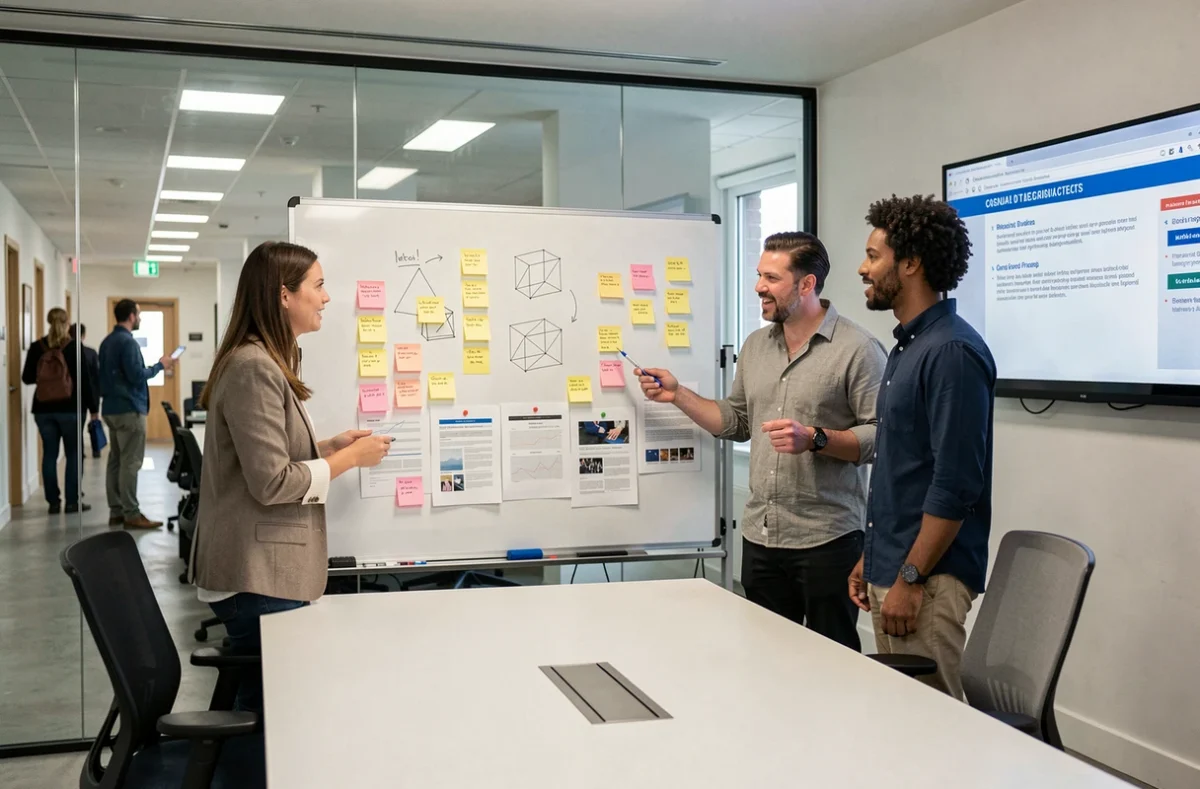
Training internal teams in gamification is cheaper than commissioning a new game for each campaign. Ludika Studio offers training sessions aimed at cultural mediators, educational teams, and communication officers who wish to integrate play into their practice.
The content of these training sessions covers the grammar of game design (feedback loops, progression curves, reward systems) applied to non-playful contexts. The goal is to make participants autonomous in creating lightweight devices: scripted quizzes, gamified paths, animation supports.
The format varies according to the client. A short one-day session is sufficient to lay the methodological foundations. Support over several weeks allows for co-developing a functional prototype with the trained team.
Evaluation of Playful Devices: Measuring Real Impact on Communication
Delivering a serious game without success indicators is akin to launching a communication campaign without a measurable objective. We observe that most gamification projects neglect the evaluation phase, even though it justifies the investment to decision-makers.
Relevant metrics depend on the context:
- In cultural mediation: completion rate of the path, time spent on each step, qualitative feedback from participants.
- In internal communication: participation rate, knowledge evolution measured by a pre-test and post-test.
- In publishing (game book, game box): sales or download volume, feedback on distribution pages, replay rate.
An evaluation protocol is defined before the game design, not after. It conditions the choice of mechanics: if the goal is to measure knowledge transfer, the game must integrate checkpoints into its progression.

Thus, Ludika Studio’s range of services covers a complete cycle, from the initial audit to post-deployment evaluation. For cultural or educational organizations considering funding a serious game project, the central question remains the same: what behavior or knowledge should the device change in the player? As long as this answer is not clearly formulated, development should not begin.